Granite vs marble for Indian kitchens
6 minute read, updated 13 October 2026
The short answer
For a counter that gets daily Indian cooking, granite. For a pooja room, flooring, a feature wall or a counter that is mostly looked at, marble is still the better-looking stone and a sound choice. The rest of this guide explains why.
What the two stones are
Granite is a hard, dense stone made mostly of quartz and feldspar. It takes a high polish and that polish is hard to damage with ordinary kitchen use. Marble is a softer stone made of calcite, and calcite reacts with acid. That one sentence explains most of what follows: anything sour on a marble counter leaves a mark, and a steel vessel dragged across it leaves a scratch.
Heat: tawa, pressure cooker, hot kadai
Granite takes a hot tawa or a cooker straight off the flame without complaint. The stone does not scorch or discolour at kitchen temperatures. Two cautions. A very hot vessel set on a cold slab can, rarely, open a hairline crack along an existing fissure or a resin-filled line. And some dark granites hold heat long enough to burn a hand a minute later. A trivet under the cooker avoids both.
Marble does not burn either. The real problem near the hob is hot oil splashing, because marble is more porous and the oil goes in.
Stains: haldi, oil, masala
Turmeric is the test every Indian counter faces. On a sealed, polished granite, a haldi smear wiped within a few minutes leaves nothing. Left overnight it may leave a faint yellow ghost on lighter granites; on blacks like Telephone Black or Madka Black you will hardly see it. Oil behaves the same way: wipe it and it is gone; let it sit for days and a lighter stone darkens in a patch.
On marble, turmeric and oil both go in. The stone is more porous and lighter marbles show every mark. A sealer slows this down; it does not stop it. If you cook with ghee and masala every day, a light marble counter beside the hob will look tired within a year, whatever you are told at the shop.
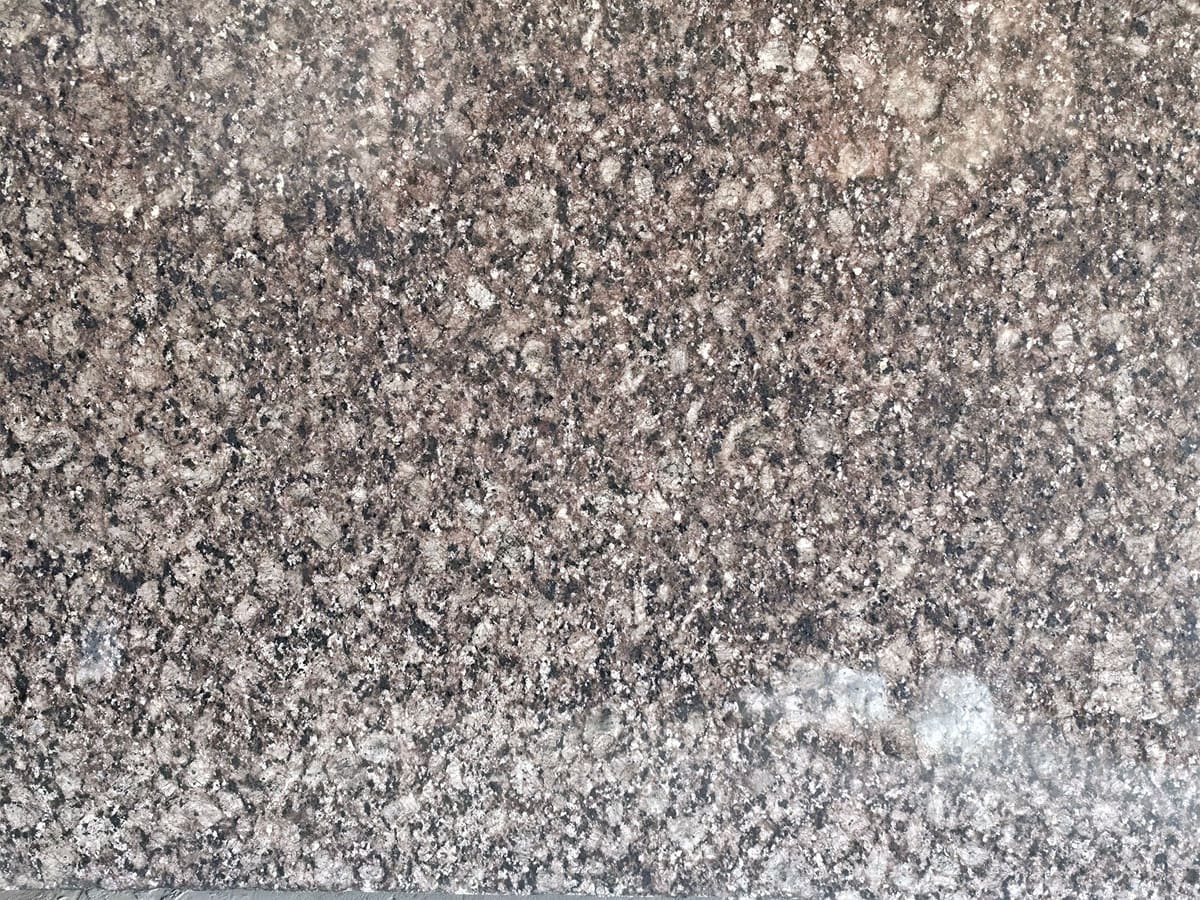
Granites vary. Lighter, more open-grained stones drink more and need sealing more often. Dense blacks, and speckled browns such as JD Brown and Chicko Brown, hide marks better in daily use. Ask about the specific slab and do the water test below.
Acids: lemon, tamarind, vinegar, tomato
This is where marble loses the kitchen. Calcite dissolves in acid. A cut lemon left face down on polished marble leaves a dull, slightly rough patch within minutes. That patch is an etch, not a stain: the polish has been eaten away. No cleaner removes it; only re-polishing does. Imli water, tomato, curd, vinegar and many cold drinks do the same.
Granite does not etch, and that is the main reason a working kitchen goes to granite.
Sealing: what it does and does not do
A penetrating sealer soaks into the surface pores and makes liquids sit on top for longer, which gives you time to wipe. It does not make a stone stain-proof and it does nothing against etching on marble. On granite, seal at installation and again when water stops beading and starts darkening the stone. On most counters that is every one to three years. On a marble counter, seal more often and still expect marks.
The water test: put a few drops on the slab and wait ten minutes. If the spot darkens, the stone drinks and needs sealing. If it beads, the slab is sealed or naturally dense.
What each looks like after five years
A polished granite counter in a busy kitchen, with ordinary care, looks much the same at five years as at one. The polish stays, the edges stay crisp, and the only visible change is perhaps a dull patch where the chopping board or the mixer always sits. Black granite shows fine scratches in low raking light; a leather finish like Black Lapatro hides them (see the guide on polished, leather and flamed finishes).
A polished marble counter in the same kitchen has lost its mirror in the working zone. There are etch rings near the sink, a yellowish tone near the hob where oil has gone in, and the matt patches stand out against the still-shiny stone at the back. It can be re-polished. In a kitchen it will dull again.
Where marble still wins
Marble’s weakness is the hob side of a kitchen counter. Elsewhere in the house it often suits better than granite.
In the pooja room there are no acids and no oil, and marble gives the room a soft light. A bookmatched pair of Kashmiri Brown or Royal Brown makes a quiet backdrop (see the guide on matching slabs from one lot).
On floors, marble has proved itself in Indian houses for generations. With the right cleaning (see the guide on caring for marble flooring) it lasts decades.
On feature walls and living-room cladding there is no wear and no staining, and the veining can be seen whole.
On bathroom vanities it works, with the caveat that some cosmetics and most bathroom cleaners etch it. On dining tables it works with mats and a little care.
A practical split
Many houses do both: granite on the working counter and the hob run, marble on the floor, in the pooja room and on the feature wall. The two sit well together when chosen as a pair, a brown granite with Kashmiri Brown, for instance, or a black counter against a pale marble floor.
Before you decide
See the actual slabs, not a sample tile. Put water on them. Ask what the finish is and what thickness you are getting (see the guide on slab thickness). If anyone tells you a particular marble is stain-proof or acid-proof, it is not.
Questions people ask
- Can I keep a hot pressure cooker directly on granite?
- In normal use, yes. A trivet is still sensible, mainly to protect a resin-filled line from thermal shock and to avoid a very hot patch of stone.
- Will turmeric stain black granite?
- Wiped in time, no. Dark polished granites are the most forgiving counters for haldi and oil; lighter granites may hold a faint yellow if a smear is left overnight.
- Is there any marble that does not etch with lemon?
- No. True marble is calcite and all of it etches. Some stones sold under a marble name are harder stones, so ask what the specific slab actually is.
- How often should I seal a granite counter?
- When water stops beading on it and starts soaking in. For most kitchens that is every one to three years; dense black granites often go longer.